Unlock the Secrets Behind the Iconic Chanel Brand
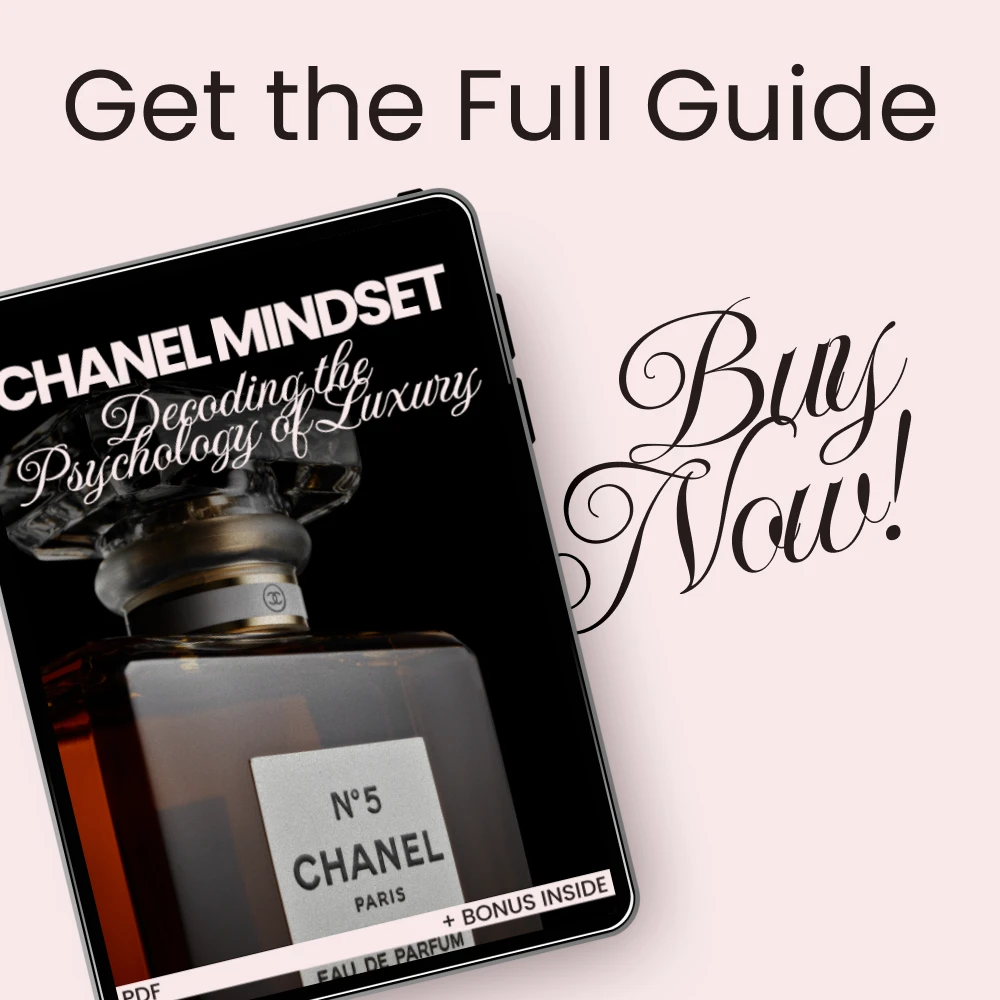
Discover the power of luxury branding and the psychology behind one of the most coveted fashion houses in the world with the Chanel Mindset: Decoding the Psychology of Luxury eBook. This comprehensive guide delves deep into the strategies and emotional triggers that make the Chanel brand a timeless symbol of elegance, freedom, and desire. Whether you’re a fashion enthusiast, an aspiring brand strategist, or simply curious about the world of luxury, this eBook is your ultimate key to understanding the emotional appeal of Chanel’s legacy and its lasting impact on the fashion industry.
Inside this guide, you’ll uncover:
- Chanel’s Origins and Identity – Learn how Gabrielle “Coco” Chanel’s vision birthed a global icon and how its core brand values shaped the brand’s identity.
- The Psychology of Luxury – Understand why consumers crave status and the emotional triggers Chanel skillfully exploits to maintain its allure.
- Chanel’s Signature Elements – Discover the role of iconic pieces like the Little Black Dress, Chanel No. 5, and timeless accessories in creating desire.
- Storytelling and Myth-Making – Explore how Chanel weaves aspirational narratives and uses celebrities and influencers to amplify its reach.
- The Science of Exclusivity – Understand how scarcity, limited editions, and VIP experiences make the brand more desirable than ever.
- Digital and AI in Modern Luxury – Learn how Chanel embraces technology with AI-powered marketing, virtual try-ons, and digital fashion shows.
- Common Brand Mistakes – Avoid common pitfalls by analyzing competitor failures and aligning your brand messaging.
- Next Steps for Aspiring Brand Strategists – Gain practical tools and exercises to apply the psychology of Chanel to your own brand strategy.
Who is this eBook for?
This guide is perfect for fashion lovers, marketers, and entrepreneurs who want to harness the psychology of luxury branding to elevate their own businesses. It’s also an invaluable resource for anyone fascinated by the power of brand identity and the emotional connection brands create with consumers.
What makes it different?
Unlike other generic guides, this eBook takes a detailed, research-driven approach to decoding the Chanel brand psychology. You won’t just learn the theory; you’ll gain actionable insights and practical tools to apply the principles to your own brand, making this a truly unique resource.
Download your copy now
and start decoding the secrets of luxury branding with Chanel Mindset: Decoding the Psychology of Luxury. Understand how to build a brand that lasts and captivates consumers just as Chanel has done for over a century.
Order cancellation
All orders can be cancelled until they are shipped. If your order has been paid and you need to make a change or cancel an order, you must contact us within 12 hours. Once the packaging and shipping process has started, it can no longer be cancelled.
Refunds
Your satisfaction is our #1 priority. Therefore, you can request a refund or reshipment for ordered products if:
- If you did not receive the product within the guaranteed time( 45 days not including 2-5 day processing) you can request a refund or a reshipment.
- If you received the wrong item you can request a refund or a reshipment.
- If you do not want the product you’ve received you may request a refund but you must return the item at your expense and the item must be unused.
We do not issue the refund if:
- Your order did not arrive due to factors within your control (i.e. providing the wrong shipping address)
- Your order did not arrive due to exceptional circumstances outside the control of Fancin (i.e. not cleared by customs, delayed by a natural disaster).
- Other exceptional circumstances outside the control of https://fancin.com
*You can submit refund requests within 15 days after the guaranteed period for delivery (45 days) has expired. You can do it by sending a message on Contact Us page
If you are approved for a refund, then your refund will be processed, and a credit will automatically be applied to your credit card or original method of payment, within 14 days.
Exchanges
If for any reason you would like to exchange your product, perhaps for a different size in clothing. You must contact us first and we will guide you through the steps.
Please do not send your purchase back to us unless we authorise you to do so.
Your files will be available to download once payment is confirmed.



The chapter on emotional triggers completely changed how I think about my own brand positioning.
Finally a guide that explains WHY people pay for luxury, not just what luxury looks like. The section on the CC logo and color psychology was surprisingly deep for how concise it was. I've already started applying the scarcity framework to my boutique.
✨👜🖤
The Gabrielle Bag mini case study in Chapter 1 alone was worth reading the whole thing. Narrative-first marketing is something I've been doing wrong for years.
Really solid breakdown of how heritage creates cultural authority.
I've read a lot of branding books and most of them recycle the same ideas. This one actually digs into the psychology — the part about dopamine activation when purchasing luxury items, and how Chanel No.5 functions as a mobile olfactory logo, is the kind of analysis I've never seen written so clearly. I run a small jewelry brand and I've been struggling with how to position it. After reading Chapter 3 on creating iconic desire, I sat down and identified my anchor product for the first time. I also restructured my Instagram based on the visual recognition section — black palette, minimal text, let the object speak. Within two weeks engagement climbed noticeably. I'm now working through the emotional trigger mapping exercise in Chapter 8.
The myth-making chapter hits different when you realize Chanel campaigns never actually sell the product.
Chapter 5 on exclusivity gave me a real framework for why I shouldn't discount my products. The loss aversion point is something I knew intuitively but couldn't articulate to clients. Now I can.
The AI application ideas woven throughout each chapter are what separate this from older marketing guides. Practical and forward-thinking.
Short, dense, and actually useful. The three brand pillars — elegance, freedom, timelessness — and the explanation of how they act as invisible magnets clicked for me immediately.
❤️🔥⭐⭐⭐⭐⭐
Before reading this, my brand story was basically a timeline of when I started the business. After the storytelling chapter, I rewrote my entire About page around an emotional narrative instead. It's a small shift but the response from customers has been completely different — people are actually connecting with it now. The Margot Robbie campaign case study in Chapter 4 helped me understand that you can generate massive engagement without ever directly selling. I applied that to my last product launch and got triple my usual email open rate.
The psychological loop in Chapter 3 — recognize, desire, internalize — is a clean and memorable model.
The section on misaligned messaging in Chapter 7 made me audit every post on my brand feed. Found three that completely contradicted my positioning. Gone now.
As someone who studied marketing formally, I was skeptical this would add anything new. I was wrong. The integration of consumer psychology with AI applications throughout each chapter is genuinely useful and not something my coursework covered. The prompt examples are especially practical — I used the sentiment analysis one as a brief for my social media manager.
Good overview but I wish the chapter on digital and AI went deeper on specific tools rather than staying conceptual.
The VIP experience section explains perfectly why Chanel show invitations are a marketing tool not just an event logistics decision.
Read this in one sitting. The Little Black Dress analysis — turning the color of mourning into a symbol of sophistication — is a brilliant entry point into how meaning gets reassigned through branding.
The final chapter exercises are genuinely actionable. Most branding books end with vague inspiration. This one ends with specific mapping tasks.
👌✨💼
Loved the Marilyn Monroe and Lily-Rose Depp comparison in the celebrity chapter — shows how the brand refreshes its aspirational figures without losing its identity.
The concept of an anchor product really resonated. I'd never thought about identifying one product to carry the full emotional weight of a brand. Now I can't stop thinking about what mine is.
Well written but the competitor case studies in Chapter 7 are anonymized which makes them feel less credible. I understand why, but it weakens the point.
The explanation of how quilted leather and chain straps function as cognitive brand shorthand without showing the logo is one of the sharpest points in the whole guide.
I've been working in fashion retail for six years and I still found new angles here, especially around how VIP exclusivity amplifies desire among those not invited. We've underused that principle completely.