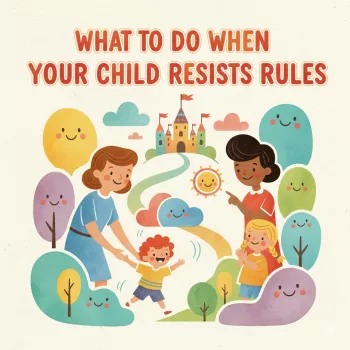
Rule resistance can look like arguing, ignoring, stalling, or melting down—often at the exact moment a parent needs cooperation. A calm, confident response starts with knowing what to do next. The goal isn’t “winning” a power struggle; it’s keeping boundaries clear while helping your child borrow your calm long enough to do the next right thing. For more guidance, see SFP-Lesson-4-Handouts.pdf.
When a child resists a rule, it’s often a signal—not a character flaw or proof that “nothing works.” Resistance commonly shows up when a need is unmet: autonomy (“I want to choose”), connection (“I need you close”), sensory comfort (scratchy clothes, loud spaces), hunger, fatigue, or overwhelm. For further reading, see Positive Discipline: A Guide for Parents.
It also helps to separate understanding from ability. Many kids fully understand the rule but don’t yet have the skill to follow it consistently—especially skills like transitioning, waiting, stopping a preferred activity, or shifting attention. When the demand is bigger than your child’s capacity in that moment, escalation becomes more likely.
Firm boundaries can still be delivered kindly. A steady tone, brief language, and predictable follow-through reduce the urge to fight back and help your child feel safe—even when they’re mad about the limit.
Before you enforce a boundary, take a tiny pause to get your nervous system back online. This isn’t “letting it slide”—it’s setting yourself up to lead.
For evidence-based guidance on age-appropriate expectations and supportive discipline, the CDC’s parenting resources are a helpful reference: American Academy of Pediatrics: Positive Parenting Tips (via CDC).
When you’re in the moment, simple beats perfect. Use this sequence as a repeatable script—especially during transitions, routines, and high-emotion times.
| Situation | Calm script | Follow-through |
|---|---|---|
| Leaving the park | “You’re having fun. It’s time to go. Do you want to walk or hop to the car?” | If no choice: “I’ll help your body.” Carry/guide calmly; debrief later. |
| Screen time ending | “Stopping is hard. Screens are done. Do you want to turn it off or should I?” | If refusal: turn off once; offer a bridge activity (snack, book, outside). |
| Hitting/throwing | “I won’t let you hit. Hands are for helping.” | Block gently; move objects; guide to a safe space; repair when calm. |
| Not doing a routine (teeth/bed) | “Your body needs rest. Pajamas first, then book. Which pajamas?” | If stalling: keep sequence; reduce extras; lead with calm physical guidance if needed. |
Follow-through is where gentle parenting becomes real-life parenting. Decide ahead of time what is non-negotiable (safety, health, respect) and where flexibility is allowed (order of tasks, timing within a window). Flexibility lowers friction; firmness keeps your child safe and builds trust.
If you want a deeper overview of respectful, developmentally appropriate discipline, HealthyChildren.org (AAP) offers strong guidance: Discipline and Behavior Guidance.
Start with one empathy sentence, restate the rule in a single clear line, offer a limited choice, and then follow through calmly if refusal continues. Keep your language brief and avoid debating.
Use respectful, related consequences like repair, redo, or removing access to the unsafe activity, and keep requests neutral with “when/then” wording. Consistent routines and teaching the missing skills support cooperation over time.
Shift from teaching to co-regulation: keep everyone safe, lower stimulation, stay nearby, and use minimal words. Return to the rule later and practice it when your child is calm.




Leave a comment