Product Description
Discover the captivating journey of one of the most iconic fashion houses in the world with our digital guide, How Saint Laurent Brand Identity Evolved Over Time. This comprehensive eBook takes you through the fascinating evolution of the Saint Laurent brand, from its groundbreaking inception to its modern-day reinvention. Whether you’re a fashion enthusiast, brand strategist, or creative professional, this guide provides invaluable insights into how a powerful brand identity is built, reinvented, and maintained across generations.
Inside this carefully curated guide, you’ll uncover the key moments that shaped Saint Laurent’s distinct and ever-evolving brand identity. Learn about the legacy of Yves Saint Laurent’s vision, the impact of Hedi Slimane’s transformative era, and the smooth continuation under Anthony Vaccarello’s creative leadership. This guide isn’t just a history lesson; it’s a roadmap for understanding the principles of brand evolution and how you can apply them to your own brand-building efforts.
Key Features:
- Chapter 1: The Foundations of Saint Laurent Identity – Explore Yves Saint Laurent’s original vision and the birth of the Parisian edge.
- Chapter 2: Modern Reinvention and Creative Shifts – Delve into the pivotal shifts during the Hedi Slimane era and how Anthony Vaccarello brought continuity with fresh perspectives.
- Chapter 3: Common Mistakes Brands Make During Rebranding – Avoid costly rebranding pitfalls such as changing too much too fast and losing emotional consistency.
- Chapter 4: Using AI to Track and Guide Brand Evolution – Learn how AI tools can help you analyze brand perception and create smarter strategies for brand growth.
Practical Benefits:
- Gain a deeper understanding of the Saint Laurent brand identity evolution and what made it a symbol of style and sophistication.
- Learn about the key creative shifts and leadership decisions that helped shape the brand’s lasting success.
- Discover actionable insights that will help you avoid common mistakes brands make during rebranding.
- Understand how to leverage AI in guiding your brand’s evolution and maintaining relevance in a fast-changing market.
This guide is perfect for marketers, brand managers, designers, or anyone with an interest in fashion branding. It’s not just a look back at the history of Saint Laurent; it’s a masterclass in how to approach brand identity evolution in a way that’s both strategic and emotionally resonant. Whether you’re starting your own brand or looking to refine an existing one, this resource is an essential tool for anyone wanting to understand the intricate details of brand identity evolution.
Download Now
Ready to dive into the world of Saint Laurent and unlock the secrets behind their successful brand evolution? Download the guide today and start your journey toward mastering brand identity evolution. Whether you’re building a new brand or reimagining an existing one, this guide is the perfect resource to ensure you’re on the right path.
Order cancellation
All orders can be cancelled until they are shipped. If your order has been paid and you need to make a change or cancel an order, you must contact us within 12 hours. Once the packaging and shipping process has started, it can no longer be cancelled.
Refunds
Your satisfaction is our #1 priority. Therefore, you can request a refund or reshipment for ordered products if:
- If you did not receive the product within the guaranteed time( 45 days not including 2-5 day processing) you can request a refund or a reshipment.
- If you received the wrong item you can request a refund or a reshipment.
- If you do not want the product you’ve received you may request a refund but you must return the item at your expense and the item must be unused.
We do not issue the refund if:
- Your order did not arrive due to factors within your control (i.e. providing the wrong shipping address)
- Your order did not arrive due to exceptional circumstances outside the control of Fancin (i.e. not cleared by customs, delayed by a natural disaster).
- Other exceptional circumstances outside the control of https://fancin.com
*You can submit refund requests within 15 days after the guaranteed period for delivery (45 days) has expired. You can do it by sending a message on Contact Us page
If you are approved for a refund, then your refund will be processed, and a credit will automatically be applied to your credit card or original method of payment, within 14 days.
Exchanges
If for any reason you would like to exchange your product, perhaps for a different size in clothing. You must contact us first and we will guide you through the steps.
Please do not send your purchase back to us unless we authorise you to do so.
Your files will be available to download once payment is confirmed.


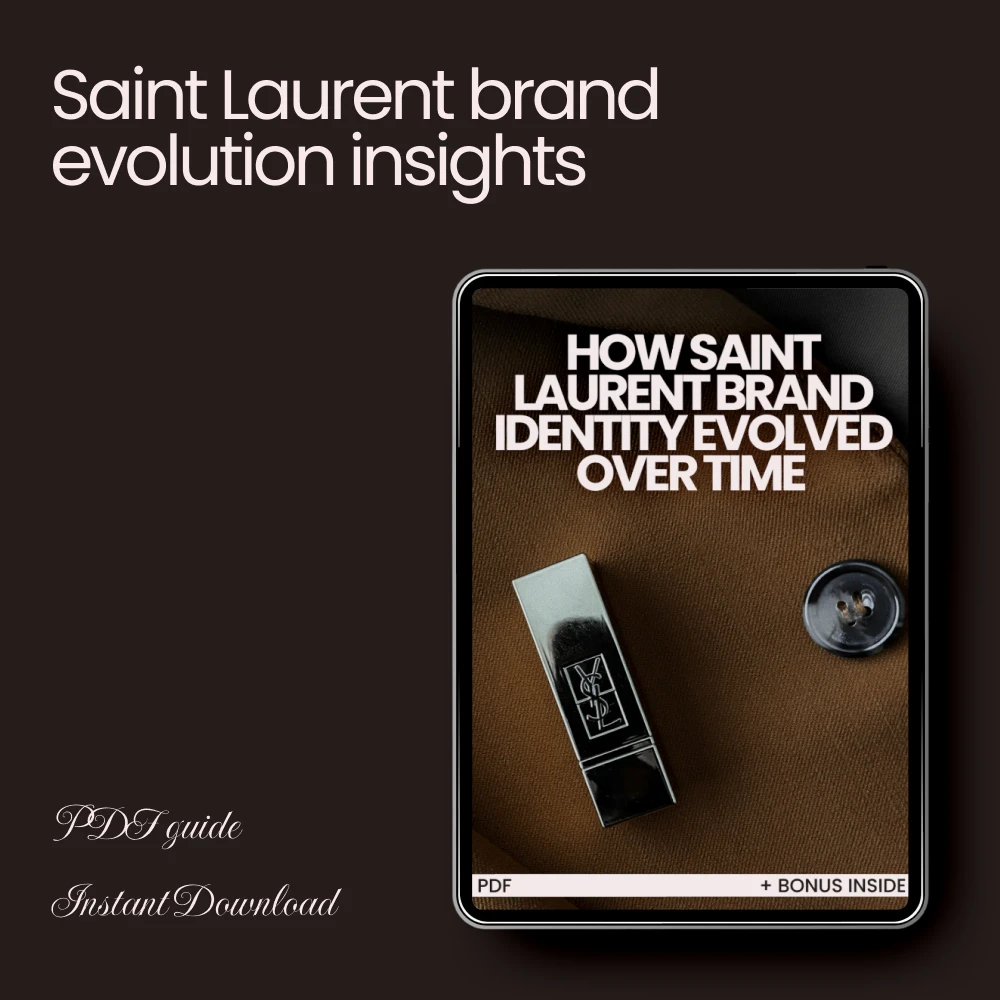


The logo case study alone made this worth reading — keeping the YSL monogram on accessories while modernizing the main wordmark is such a smart move.
I run a small fashion label and Chapter 3 stopped me from making a huge rebranding mistake. I was about to overhaul my logo, packaging, tone, and product line all at once because I wanted to signal growth. The section on changing too much too fast made me realize I was about to create identity shock for my existing customers. Instead I mapped my non-negotiable elements first — exactly like the guide suggests — and now I'm rolling changes out gradually. My audience has responded so much better to the slower approach.
The Parisian edge concept — sophistication meets rock-inspired attitude — is the clearest definition of the YSL mood I've seen.
Read it in under an hour. Every chapter builds on the last.
Chapter 2 comparing the Slimane and Vaccarello eras side by side was fascinating. Sharpening vs refining — two completely different strategies that both worked because they stayed aligned with the house's emotional core. The guide makes it clear that the market accepted both shifts because neither felt random. That's the real insight here. I've been studying brand strategy for years and this is one of the most concise breakdowns of successful creative director transitions I've come across.
The emotional consistency section in Chapter 3 is something every brand builder needs to internalize.
Smart, tight, and practical. No padding.
The point about identity being built through disciplined repetition — not single moments — reframed how I think about branding entirely.
⭐🖤🔥👏
Chapter 1 on Yves Saint Laurent's original vision gave me chills. Modern elegance mixed with quiet rebellion — that tension is what makes the brand magnetic even decades later.
Solid brand analysis but the AI section felt lighter than the rest — I wanted specific tool recommendations alongside the prompts.
The section on ignoring core audience expectations while chasing new markets is a trap I've seen destroy brands firsthand.
The distinction between visual evolution and emotional consistency is the most valuable framework in this entire guide. I manage brand strategy for a mid-size company and we were about to launch a rebrand focused almost entirely on new visuals — new colors, new typography, new photography style. After reading Chapter 3 I went back to my team and asked a question we'd never discussed: what feelings need to stay constant? That one question changed our entire approach. We kept the emotional core and updated the surface. The response from our customers has been overwhelmingly positive.
Finished this on a flight and immediately started mapping my own brand's non-negotiable identity elements.
The Vaccarello section on refined continuity is a masterclass in how to take over a brand without breaking it.
How the guide frames growth as expanding the brand world rather than rejecting the original community — that's the line I keep thinking about.
Concise and insightful. Reads more like a brand strategy deck than a typical fashion PDF.
The early signals section in Chapter 1 — black tones, sharp silhouettes, ties to music and nightlife — explains exactly how a brand trains consumers to feel something specific over time 🤍
That concept of mental shortcuts built through disciplined repetition applies way beyond fashion.
I teach a fashion marketing course and I'm adding this to my reading list. The Slimane era analysis is particularly well done — it shows how intensifying existing DNA is different from reinvention. The guide explains that he didn't abandon the brand's codes, he sharpened them. Skinnier tailoring, deeper music culture ties, more youthful energy — but all within the Parisian edge framework the house had already established. My students need to understand this difference between evolution and disruption, and this PDF explains it better than most textbooks.
The logo transition case study is the best example of balancing modernization with heritage protection I've read.
Short enough to read in one sitting, dense enough to reference for months.
The AI prompts for comparing audience sentiment before and after rebranding moves are surprisingly practical.
Chapter 3 on rebranding mistakes should be printed and framed in every CMO's office.
The way this connects Yves's original vision to what the brand looks like today shows just how stable the emotional core has been across sixty years.