Product Description
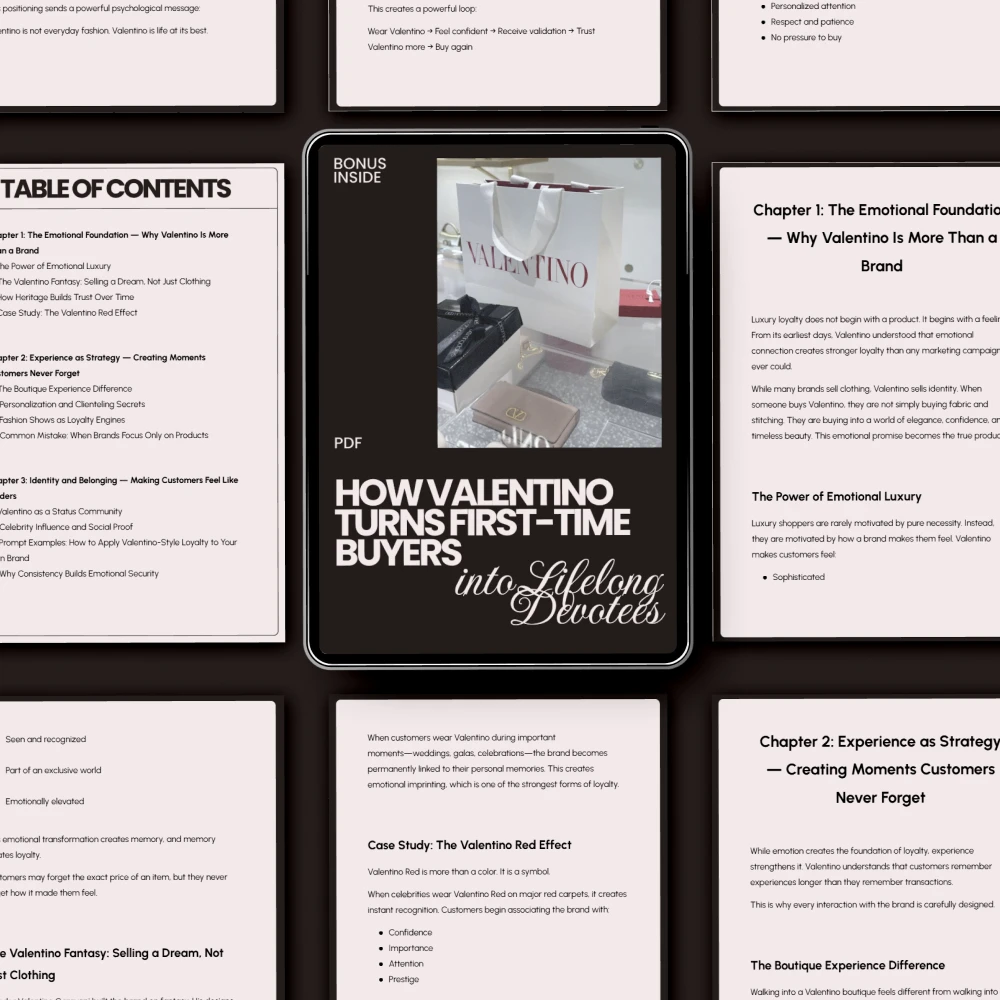
Unlock the secrets of Valentino’s success in this exclusive digital guide, *How Valentino Turns First-Time Buyers into Lifelong Devotees*. Whether you’re a luxury brand owner or a fashion enthusiast, this in-depth guide reveals the strategies Valentino uses to build unparalleled loyalty and convert first-time buyers into dedicated, lifelong customers. Discover how emotional connection, personalized experiences, and strategic branding create a lasting bond with clients.
This guide delves into the core principles behind Valentino’s loyalty strategy, showing you how to apply these tactics to your own brand. Through rich examples, case studies, and actionable insights, you’ll learn how to make your customers feel like they belong and create an experience they’ll never forget.
Key Features
- Chapter 1: *The Emotional Foundation* – Explore how Valentino uses the power of emotional luxury and heritage to build trust.
- Chapter 2: *Experience as Strategy* – Learn how personalized service and unforgettable boutique experiences drive customer loyalty.
- Chapter 3: *Identity and Belonging* – Discover how Valentino fosters a sense of exclusivity and community among its customers.
- Chapter 4: *The Future of Loyalty* – Find out how AI and technology are strengthening the bond between Valentino and its customers.
Practical Benefits
- Build loyalty the Valentino way by focusing on emotional connection and heritage.
- Enhance your customer experience with personalized touches that make each customer feel valued and special.
- Create a sense of belonging and identity around your brand, just like Valentino does for its clientele.
- Leverage AI and cutting-edge technology to understand your customers and create more personalized experiences.
If you’ve ever wondered how Valentino creates such an enduring bond with its customers, this guide is your chance to learn those secrets. Download your copy now and start transforming your brand’s loyalty strategy today.
Order cancellation
All orders can be cancelled until they are shipped. If your order has been paid and you need to make a change or cancel an order, you must contact us within 12 hours. Once the packaging and shipping process has started, it can no longer be cancelled.
Refunds
Your satisfaction is our #1 priority. Therefore, you can request a refund or reshipment for ordered products if:
- If you did not receive the product within the guaranteed time( 45 days not including 2-5 day processing) you can request a refund or a reshipment.
- If you received the wrong item you can request a refund or a reshipment.
- If you do not want the product you’ve received you may request a refund but you must return the item at your expense and the item must be unused.
We do not issue the refund if:
- Your order did not arrive due to factors within your control (i.e. providing the wrong shipping address)
- Your order did not arrive due to exceptional circumstances outside the control of Fancin (i.e. not cleared by customs, delayed by a natural disaster).
- Other exceptional circumstances outside the control of https://fancin.com
*You can submit refund requests within 15 days after the guaranteed period for delivery (45 days) has expired. You can do it by sending a message on Contact Us page
If you are approved for a refund, then your refund will be processed, and a credit will automatically be applied to your credit card or original method of payment, within 14 days.
Exchanges
If for any reason you would like to exchange your product, perhaps for a different size in clothing. You must contact us first and we will guide you through the steps.
Please do not send your purchase back to us unless we authorise you to do so.
Your files will be available to download once payment is confirmed.




The emotional imprinting concept completely reframed how I think about my own brand
Read this in one sitting and immediately rewrote my welcome email sequence
The loyalty loop breakdown — wear, feel confident, get validated, buy again — is so obvious once you see it but I never would have articulated it myself. Applied it to my jewelry brand's messaging within an hour.
This nails why my customers buy once and disappear 🎯
I run a small boutique in Atlanta and I was doing everything wrong — pushing product, ignoring experience, treating customers like transactions. After reading the clienteling section I started remembering names, preferences, even birthdays. Within two months my repeat purchase rate doubled. One customer told me she drives past three other shops to come to mine now. The part about emotional safety really stuck with me because that's exactly what I was missing.
Solid framework but some of the AI prompts felt generic
❤️🔥👔✨
Short, dense, practical. No wasted pages.
The distinction between products creating interest and experiences creating loyalty hit different
I've read dozens of brand strategy PDFs and most are recycled fluff. This one actually connects psychology to execution. The Valentino Red case study alone is worth the download — it shows how a single color became a full emotional ecosystem. I shared it with my business partner and we restructured our entire onboarding flow around the belonging framework from chapter three.
Makes you realize loyalty isn't a program, it's a feeling
Wish it included more examples from smaller brands, not just luxury houses. The principles translate but I had to do a lot of mental adaptation on my own. Still worth the read for the emotional framework.
The boutique experience section made me completely rethink my online store's checkout flow
I never connected fashion shows to loyalty before — now I see them everywhere in how brands keep people hooked
Genuinely useful if you're building anything customer-facing 💡
Good overview, could go deeper on the digital evolution side. Felt like it was just getting started when that section ended.
The four actions at the end are pinned above my desk now
Identity-based loyalty is such a powerful concept. Once your customer thinks the brand IS them, they're not going anywhere. I see this in my own buying habits and now I know how to create it.
⭐👌🖤
Before this I thought loyalty meant points programs and discount codes. I was spending money on promotions that attracted bargain hunters who never came back. After reading the emotional foundation chapter I stopped discounting entirely and started investing in how my store made people feel — the packaging, the follow-up messages, the way I described products. My margins went up and my return rate went up with them. Turns out people don't need 15% off, they need to feel seen.
Clean writing, zero filler, actually respects your time
The consistency section is underrated — that's where most small brands fall apart
Interesting angle but I wanted more data to back up the claims about emotional imprinting. The logic makes sense intuitively but some research citations would have strengthened it.
Applied the status community idea to my membership site and retention jumped in the first month 🔥
This taught me more about branding than my marketing degree did