Discover the Power of Versace and Compare It to Other Luxury Labels
Are you a fashion enthusiast fascinated by luxury brands and their influence on the world of style? The “How Versace Stacks Up Against Luxury Labels” guide is here to give you an in-depth look at Versace, comparing it to some of the most iconic luxury fashion brands. This guide is designed to help you better understand what makes Versace stand out and how it measures up against its competitors in the world of high-end fashion.
Whether you’re a seasoned luxury fashion lover or just starting to build your luxury wardrobe, this guide provides valuable insights into Versace’s design philosophy, marketing strategies, and its role in the broader fashion ecosystem. You’ll also find practical advice for navigating the often-overwhelming luxury market, so you can make informed decisions when purchasing pieces from high-end designers.
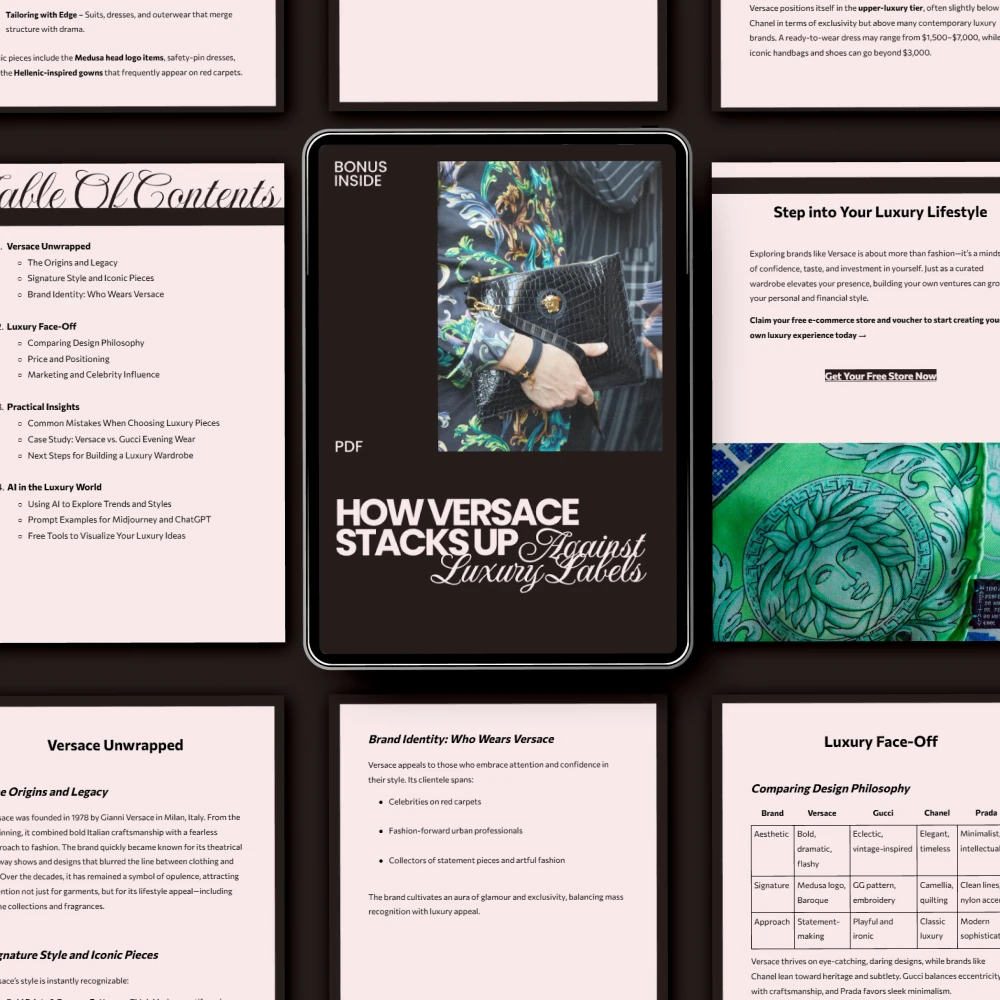
Key Features & Contents of the Guide:
- Versace Unwrapped: Learn about the origins and legacy of the brand.
- Signature Style and Iconic Pieces: Explore the designs that define Versace.
- Brand Identity: Who Wears Versace: Understand the cultural significance and celebrity influence of the brand.
- Luxury Face-Off: A detailed comparison of Versace with other luxury labels.
- Comparing Design Philosophy: Understand Versace’s approach to design and craftsmanship.
- Price and Positioning: Learn about Versace’s pricing strategies and market positioning.
- Marketing and Celebrity Influence: Discover how Versace uses marketing and celebrity endorsements to maintain its status.
- Practical Insights: Common mistakes when choosing luxury pieces and how to avoid them.
- Case Study: Versace vs. Gucci Evening Wear: A side-by-side comparison of Versace and Gucci’s evening wear collections.
- Next Steps for Building a Luxury Wardrobe: A guide on how to expand your collection thoughtfully.
- AI in the Luxury World: How AI is changing the way we shop for luxury goods.
- Using AI to Explore Trends and Styles: How to use artificial intelligence to discover fashion trends.
- Prompt Examples for Midjourney and ChatGPT: Tools and tips for using AI to visualize your luxury ideas.
- Free Tools to Visualize Your Luxury Ideas: A collection of helpful tools to bring your luxury wardrobe vision to life.
Who is This Guide For?
This guide is perfect for anyone passionate about luxury fashion, especially those interested in Versace. Whether you are new to luxury fashion or an experienced shopper, this guide will provide you with the knowledge you need to make smart, informed choices. It’s ideal for fashion enthusiasts, collectors, and anyone looking to build or refine their luxury wardrobe.
Why Choose This Guide?
Unlike other resources, “How Versace Stacks Up Against Luxury Labels” goes beyond basic comparisons, offering detailed insights into Versace’s design philosophy, celebrity influence, and practical tips for navigating the luxury market. This guide also explores the intersection of AI and luxury fashion, giving you modern tools to stay ahead of trends. It’s more than just a comparison—it’s an essential resource for anyone looking to truly understand the luxury fashion landscape.
Ready to take your fashion game to the next level? Download “How Versace Stacks Up Against Luxury Labels” today and start building your perfect luxury wardrobe with confidence!
Order cancellation
All orders can be cancelled until they are shipped. If your order has been paid and you need to make a change or cancel an order, you must contact us within 12 hours. Once the packaging and shipping process has started, it can no longer be cancelled.
Refunds
Your satisfaction is our #1 priority. Therefore, you can request a refund or reshipment for ordered products if:
- If you did not receive the product within the guaranteed time( 45 days not including 2-5 day processing) you can request a refund or a reshipment.
- If you received the wrong item you can request a refund or a reshipment.
- If you do not want the product you’ve received you may request a refund but you must return the item at your expense and the item must be unused.
We do not issue the refund if:
- Your order did not arrive due to factors within your control (i.e. providing the wrong shipping address)
- Your order did not arrive due to exceptional circumstances outside the control of Fancin (i.e. not cleared by customs, delayed by a natural disaster).
- Other exceptional circumstances outside the control of https://fancin.com
*You can submit refund requests within 15 days after the guaranteed period for delivery (45 days) has expired. You can do it by sending a message on Contact Us page
If you are approved for a refund, then your refund will be processed, and a credit will automatically be applied to your credit card or original method of payment, within 14 days.
Exchanges
If for any reason you would like to exchange your product, perhaps for a different size in clothing. You must contact us first and we will guide you through the steps.
Please do not send your purchase back to us unless we authorise you to do so.
Your files will be available to download once payment is confirmed.





🔱🏆👠❤️
Cinematic ad campaigns as a brand strategy point — actually explains Versace's cultural stickiness.
I found this guide while trying to explain to a younger colleague why a trending Versace Baroque-print jacket was likely a mistake for her wardrobe. I'd been attempting to articulate it for twenty minutes when I pulled this up — it said what I was trying to say in one sentence: buying for trend alone means pieces that look outdated quickly, and Versace's power is in its timeless statement items, not its seasonal noise. She read the whole thing on her phone while we finished lunch. The comparison table was the entry point that got her attention — she'd been conflating Versace's boldness with Gucci's eccentricity and treating them as interchangeable flashy options, which explained why a previous Gucci purchase had disappointed her at a high-impact event. The distinction that Versace is for attention-grabbing impact and Gucci for subtle eccentricity is the single most useful line for anyone navigating a first luxury purchase. She ended up using the Midjourney prompt — a Versace-inspired gown with Medusa motifs, metallic gold accents, and dramatic draping — to visualize options before committing, which I'd never have thought to suggest. The structured Versace outerwear piece she eventually chose was from an older season rather than the trending one, and it works with everything she already owns. The mix of high and mid-luxury strategy also gave her permission to invest in one quality Versace piece rather than feeling pressure to buy into the full range — that recalibration alone was worth the read.
Good foundation on Versace's origin and Baroque signatures — brand identity needed more depth.
The framing of Versace as a lifestyle brand — home collections and fragrances extending the opulence beyond garments — is handled with enough specificity to matter. The brand doesn't just sell clothes, it sells an environment, and the guide communicates that without overloading on descriptive language. For anyone building a coherent luxury vision rather than a random wardrobe, that distinction is load-bearing.
Knowing Versace sits below Chanel in exclusivity but above most contemporaries clarifies the decision.
The Medusa head logo items, safety-pin dresses, and Hellenic-inspired gowns as iconic anchors are the right starting point for understanding where Versace's signature strength actually lives. It's not in logo repetition but in those specific silhouettes that keep reappearing on major red carpets. The guide gets that distinction right.
Accurate overview of Versace's celebrity strategy — the AI tools listing felt tacked on.
The practical decision framework here — choose Versace for attention-grabbing impact, choose Gucci for subtle eccentricity — cuts through years of fashion commentary that treats both brands as variations on the same theme 🔥 Working in event styling, I've watched clients make exactly the overmixing mistake described here: layering Versace Baroque prints over Gucci GG accessories and wondering why the look reads as chaotic instead of curated. The vocabulary this guide gives you for why competing aesthetics dilute rather than amplify each other is genuinely useful in client consultations. The common mistakes section — all four points, especially overmixing brands and neglecting occasion — maps directly onto errors I correct most often.
Versace's history of theatrical runway shows blurring clothing and art wasn't something I expected to find summarized this cleanly in a short guide. That context matters because it explains why Versace pieces often read as artistic objects rather than just clothing — the design intention was always to blur that line. Knowing that changes how you evaluate individual pieces.
Fashion-forward urban professionals as a distinct Versace audience is a more accurate read.
The Versace versus Gucci case study and the four-brand table are both strong — specific enough to be useful for actual purchase decisions. The advice about mixing high and mid-luxury items is also practically useful for people who don't have unlimited budgets. What I kept waiting for was more on Versace's resale market: the price section covers retail but doesn't address how Versace holds value compared to Chanel or whether certain iconic pieces appreciate, which significantly changes the investment calculus.
The overlap between high drama and genuine craftsmanship is where this guide earns its read.
Versace since 1978 — the origin context makes the Medusa symbolism feel intentional, not just decorative.
The Versace versus Gucci evening wear case study is a compact model for how luxury brand comparison writing should work: specific criteria, distinct conclusions, actionable takeaways. Most comparisons hedge at the end with something like 'it depends on personal style,' which is useless. This one actually says Versace belongs in red carpet and nightlife settings while Gucci fits artistic and semi-formal contexts, and then explains why that distinction holds. The mistake about neglecting occasion — flagging ultra-bold Versace at a conservative event specifically — is the applied knowledge that follows naturally from that comparison. The wardrobe building section is the practical close the guide needs: identify key pieces, balance with neutral basics, research heritage before purchasing, mix price tiers thoughtfully.
Smart on brand positioning — more on how Versace's design evolved post-Gianni would help.
The point about social media engagement emphasizing lifestyle over individual products is a key insight into how Versace maintains aspirational positioning without becoming overexposed. It's the same principle as the theatrical runway approach — selling an aura, not an object. The guide reads these marketing patterns accurately and connects them to brand identity in a way that's useful for anyone studying luxury strategy.
Structured tailoring merging with drama — that's Versace's formal wear described in exactly the right terms.
The AI visualization section — specifically using Canva and Figma for mood boards with fabrics, patterns, and accessories — bridges the gap between trend research and actual styling decisions. It's practical enough to use immediately, which is rarer than it sounds in luxury content. The Pinterest recommendation for runway-to-street-style tracking is similarly direct.
The brand comparison table helps, but the guide barely covers Versace's more divisive pieces.
Building a luxury wardrobe around a few key pieces that reflect your style — a statement dress, a tailored blazer, a signature bag — is advice most guides complicate unnecessarily. The specificity here is what makes it land: not just 'invest in classics' but choose Versace when you need attention-grabbing impact and know your occasion. The mistake about ignoring fit and comfort hits differently when framed as a luxury failure — a $3,000 bag or $5,000 dress that doesn't work for your body isn't luxury, it's an expensive compromise. The comparison of Versace's upper-luxury positioning against Chanel's higher exclusivity is more candid than most brand ranking conversations, which usually flatten everything or refuse to rank at all.
The Versace lifestyle framing — home collections and fragrances extending the same opulence as the garments — makes it clear the brand is building a world, not just a wardrobe 🌟 That context is why the Medusa motif appears on everything from clutches to home pieces without feeling diluted: it's a coherent symbol across a coherent universe. Understanding that changes how you approach a first purchase.
Price anchors for RTW and handbags give this real-world utility most brand overview pieces skip.
The Versace versus Chanel design philosophy distinction — bold, dramatic, statement-making versus elegant and timeless — is explained with real clarity, and the four-brand table is a reference I'll keep. The practical mistakes section is also useful. My concern is with the AI tools: recommending Polyvore clones and Looklet alongside Canva and Figma is fine, but some of those platforms have changed significantly or reduced functionality, and more current recommendations would've made that section more durable.
🔥✨