Redefining Luxury in a New Era
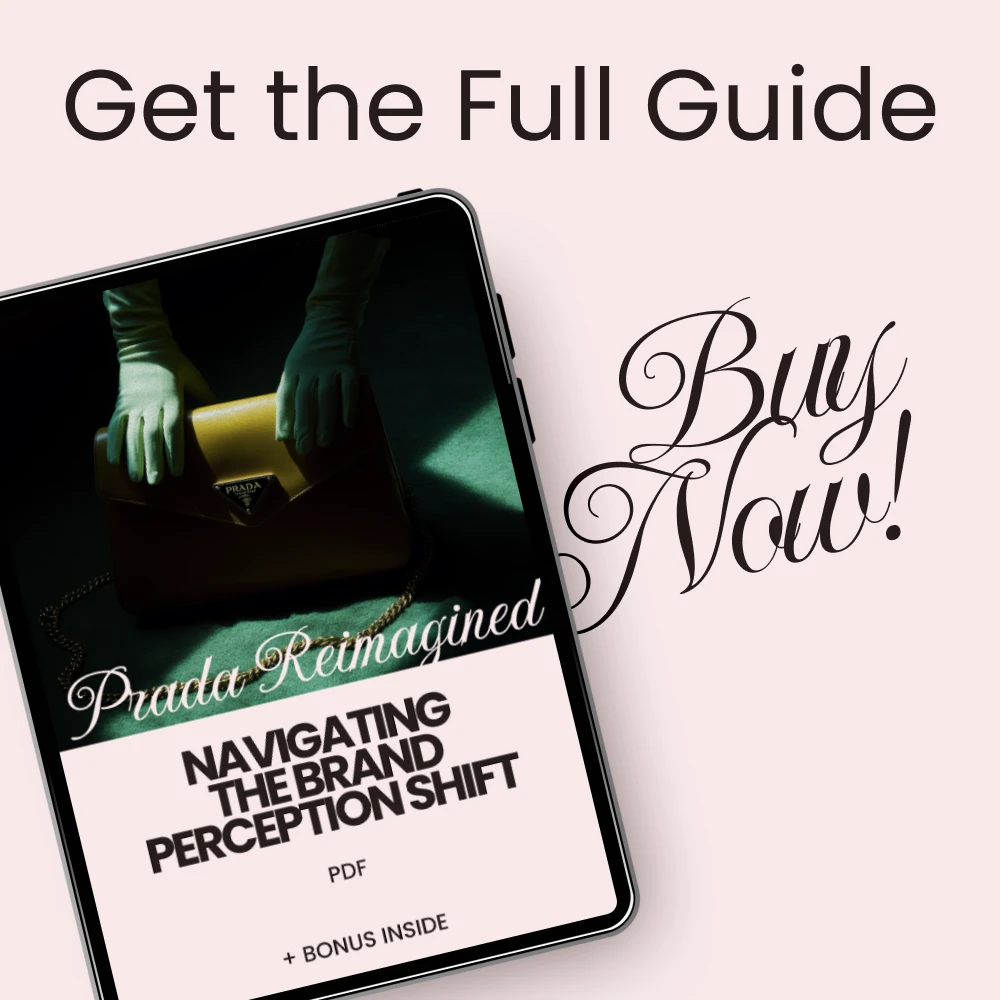
Luxury is no longer just about heritage—it’s about relevance. Prada Reimagined: Navigating the Brand Perception Shift is a powerful, insight-driven ebook that unpacks one of the most fascinating transformations in modern fashion. If you’ve been curious about the prada brand perception shift and how an iconic house adapts to cultural change, digital disruption, and evolving consumer expectations, this guide gives you a clear, strategic roadmap. Designed for fashion professionals, brand builders, marketers, and creators, this digital download delivers practical insights you can apply immediately.
What’s Inside This eBook
- Chapter 1: Prada’s legacy, core brand values, and its current market identity
- Chapter 2: The cultural and consumer forces driving the prada brand perception shift
- Chapter 3: Strategic product innovation, collaborations, and narrative-changing marketing campaigns
- Chapter 4: AI in fashion branding, including predictive analytics, personalization, and virtual engagement
- Chapter 5: Case studies comparing Prada with Gucci, Balenciaga, and Louis Vuitton
- Chapter 6: Common branding pitfalls and how to avoid costly mistakes
- Chapter 7: Step-by-step brand audit guidance, perception shift roadmap, and AI prompt examples
- Chapter 8: The future of luxury fashion, sustainability, and digital influence
Why You’ll Love It
- Gain a deep understanding of the prada brand perception shift and how it reflects broader luxury trends
- Learn actionable branding strategies you can apply to your own fashion or creative business
- Discover how AI tools can transform marketing, customer insights, and trend forecasting
- Avoid common brand positioning mistakes that weaken identity and credibility
- Access structured frameworks instead of scattered online articles
Who This Is For
This ebook is ideal for fashion entrepreneurs, marketing professionals, brand strategists, design students, content creators, and anyone building a premium or luxury brand. Whether you manage an emerging label or study high-fashion business models, this guide translates the prada brand perception shift into clear, usable strategy.
What Makes It Different
Unlike generic fashion business books, Prada Reimagined: Navigating the Brand Perception Shift blends heritage analysis with modern AI strategy. It combines brand history, competitor case studies, digital transformation insights, and practical implementation steps in one cohesive resource. You’re not just learning what happened—you’re learning how to replicate strategic evolution in your own brand.
Download Your Copy Today
If you’re ready to understand how iconic brands evolve—and how you can engineer your own transformation—this ebook is your blueprint. Download Prada Reimagined: Navigating the Brand Perception Shift today and start building a future-proof brand strategy with clarity and confidence.
Order cancellation
All orders can be cancelled until they are shipped. If your order has been paid and you need to make a change or cancel an order, you must contact us within 12 hours. Once the packaging and shipping process has started, it can no longer be cancelled.
Refunds
Your satisfaction is our #1 priority. Therefore, you can request a refund or reshipment for ordered products if:
- If you did not receive the product within the guaranteed time( 45 days not including 2-5 day processing) you can request a refund or a reshipment.
- If you received the wrong item you can request a refund or a reshipment.
- If you do not want the product you’ve received you may request a refund but you must return the item at your expense and the item must be unused.
We do not issue the refund if:
- Your order did not arrive due to factors within your control (i.e. providing the wrong shipping address)
- Your order did not arrive due to exceptional circumstances outside the control of Fancin (i.e. not cleared by customs, delayed by a natural disaster).
- Other exceptional circumstances outside the control of https://fancin.com
*You can submit refund requests within 15 days after the guaranteed period for delivery (45 days) has expired. You can do it by sending a message on Contact Us page
If you are approved for a refund, then your refund will be processed, and a credit will automatically be applied to your credit card or original method of payment, within 14 days.
Exchanges
If for any reason you would like to exchange your product, perhaps for a different size in clothing. You must contact us first and we will guide you through the steps.
Please do not send your purchase back to us unless we authorise you to do so.
Your files will be available to download once payment is confirmed.



AI micro-segmentation enabling personalized limited release invites — exclusivity maintained at scale.
The eight-chapter build from Prada's founding history through to AI-driven future strategy is logically sequenced, and the practical AI prompt examples are immediately usable for any marketing team. The overextension section is the most useful pitfall analysis in the guide. Where I'd want more: the line between successful modernization and brand dilution is narrower in practice than the strategic framing implies, and more guidance on reading those signals before it's too late would complete the picture.
Experience over ownership as luxury's new direction — that shift has immediate strategic implications.
🎨💼⭐
Balenciaga's risk-versus-reward lesson — boldness drives visibility, but misaligned campaigns generate backlash rather than buzz — is the most useful warning in the competitive analysis. Watching a brand with high creative talent damage itself by pushing boundaries without checking alignment is more common than it should be. Naming that mechanism precisely, rather than offering the standard 'know your audience' guidance, makes this the section I'd excerpt for clients tempted by shock-value thinking.
The three pillars of Prada's brand identity and the Miuccia Prada transformation section are handled with precision, and the roadmap from brand audit through AI-driven iteration is logically structured. The gap is in measurement: naming engagement, sentiment, sales, and brand recognition as metrics to track is a starting point, not a methodology — a guide at this depth should resolve how you determine which touchpoint actually drove the perception change when multiple things shifted simultaneously.
The brands that didn't adapt digitally are all the proof this guide needs.
Presenting the competitor monitoring analysis to a strategy team I was advising, the table comparing Gucci's meme model, Balenciaga's shock approach, and LV's artist integration opened one of the most productive strategic discussions we'd had all year. Seeing three approaches mapped side by side with outcomes and key lessons forced the conversation from 'which do we prefer aesthetically' to 'which model aligns with our heritage and what risks does each carry.' The overextension pitfall section became the project's risk register — all three failure modes were live risks for this client, and structuring them with AI simulation as a pre-launch mitigation tool gave us a protocol that hadn't existed before. The AI prompt examples for sentiment analysis and competitor comparison reduced our research setup significantly. The one area I'd reinforce is measurement: the metrics section tracks the right signals but doesn't address how to establish a meaningful perception baseline before the shift begins, which is the prerequisite for knowing whether the shift actually worked 🖤
AI sentiment simulation before a collaboration launch — the step most brands skip.
The Linea Rossa and Prada x Adidas case studies together complete a single argument: cultural relevance requires design risk, but collaboration value depends on equity alignment, not just audience overlap. The digital engagement metrics section gives concrete language for verifying whether that risk paid off. Beginning with heritage analysis and building through strategic transformation to AI-driven future applications, the guide's sequencing earns its conclusions.
The perception gap framing, the three-pillar brand identity analysis, and the Gucci-Balenciaga-LV comparison are all well-structured and accurate. Two things limit the practical usefulness: the AI tools coverage describes what AI can do without addressing how to implement it in actual workflows for teams that aren't yet AI-fluent, and the brand audit exercise doesn't distinguish between high-volume perception data and what's actually meaningful signal. Solid strategic orientation, but stops short as an operational guide.