-
Shop
- Adidas
- Advanced Technologies
- AI Career Advantage Collection
- AI Skills for Creators & Freelancers
- AI Client Management
- AI Ethics
- AI Mindset
- AI Tools & Prompts
- AI Writing & Content Creation
- Audio, Voice & Music
- Design & Visual Creation
- Email, Messaging & Communication
- Freelancing & Business
- Marketing, Ads & Conversion
- Productivity, Workflow & Automation
- SEO & Search Optimization
- Social Media Content & Growth
- Strategy, Planning & Analytics
- Video Creation & Editing
- AI Skills Mastery 2026 Collection
- Bathroom
- Best-Sellers
- Car Accessories
- Confidence
- Dating & Social Skills
- Digital Resources
- AI & Technology
- AI Skills
- Beauty
- Budgeting & Saving
- Car Buying & Ownership
- Cozy Feast Collection
- Electronics & Technology
- Entrepreneurship & Business Growth
- Financial Education
- Financial Independence
- Financial Mindset & Psychology
- Goal Setting
- Hobbies
- Home Styling & Organization
- Kitchen & Recipes
- Leadership
- Mindfulness
- Mindset
- Online Business
- Parenting & Child Development
- Personal Style & Fashion
- Pet Lifestyle & Wellness
- Positive Thinking
- Sleep Improvement
- Smart Life with AI
- Stress Management & Relaxation
- Travel Planning
- Wellness
- Yoga & Fitness
- Yoga & Mind-Body Practices
- Education & Learning
- Family & Parenting
- Fashion
- Furniture
- Gadgets
- Health & Beauty
- Health & Wellness
- Home & Garden
- Home Decor
- Home Electronics
- Kids & Babies
- Kitchen
- Kitchen Best-Sellers
- Lighting
- Luxury Brands Collection
- Nike
- Patio, Lawn & Garden
- Personal Growth
- Pet Care
- Pet Supplies
- Pets
- Smart Amazon Shopping
- Sport & Outdoors
- Stress Relief & Relaxation
- Travel
- Travel & Adventure
- Wealth
- Popular
- Best deals
Future-Ready AI Skills: Digital Mastery for Career Growth

AI Skills That Make You Future-Ready: Practical Digital Mastery for Career Growth
AI is changing how work gets done across roles—not just in tech. The fastest advantage comes from a balanced skill set: understanding what AI can do, using it responsibly, improving workflows with it, and communicating results clearly. This guide breaks down the most durable AI skills to build now, how to practice them quickly, and how to turn them into measurable career outcomes.
What “future-ready” means in an AI-shaped workplace
Being future-ready isn’t about memorizing tool features that will change next quarter. It’s about building steady competence that transfers across chatbots, copilots, and specialized AI systems.
- Comfort with AI as a daily tool, not a special project: drafting, summarizing, analysis, automation, and decision support.
- Ability to judge quality: spotting hallucinations, weak reasoning, missing context, and biased outputs.
- Workflows that combine human judgment with AI speed: clear goals, constraints, review steps, and documentation.
- Transferable competence across tools: consistent skills whether you’re in email, spreadsheets, CRM, design, or reporting.
The core AI skill stack (from beginner to advanced)
Think of AI capability as a stack: each layer improves results and reduces risk. When the stack is strong, you can get useful output faster—and trust it more.
- AI literacy: models, training data, tokens, context limits, strengths vs. failure modes, and common use cases by function.
- Instruction-writing: specifying objective, audience, constraints, format, and examples; iterating with critiques and checks.
- Information triage: deciding what to ask AI, what to search manually, and what needs a subject-matter expert.
- Output verification: cross-checking against sources, adding calculations, testing edge cases, and requiring citations where possible.
- Data handling basics: cleaning spreadsheets, structuring inputs, and protecting sensitive information.
- Automation mindset: turning repeated tasks into templates, checklists, and simple integrations.
AI skills to build and how to practice them
| Skill area | What it looks like at work | Fast practice (30–60 minutes) | Proof of skill |
|---|---|---|---|
| Prompting & instructions | Clear requests that produce consistent outputs | Rewrite one messy email into 3 tones; ask for a structured checklist and a final version | Reusable instruction templates + before/after examples |
| Verification & quality control | Catching errors and improving reliability | Ask for an answer + sources; validate key claims with independent references | A short QA log showing what changed and why |
| Workflow design | Repeatable steps with review gates | Map a task into: input → AI draft → human review → finalize → archive | A documented SOP others can follow |
| Data & analysis | Turning raw data into insights safely | Summarize a spreadsheet, create a pivot-table plan, and draft 3 insights + risks | A one-page analysis brief with assumptions |
| Automation & templates | Reducing recurring manual work | Create a reusable template for weekly reporting or customer replies | Time saved measured over 2–4 weeks |
| Responsible use | Privacy-aware, fair, and compliant use of AI | Redact sensitive details; create a “do not share” checklist for requests | A lightweight AI usage policy for your role/team |
Role-based AI skills that stay valuable
- For managers: define the problem clearly, set success metrics, evaluate outputs, and drive adoption without over-automating.
- For marketers and creators: ideation frameworks, audience-specific drafts, brand-consistent editing, and performance analysis with guardrails.
- For analysts: ask better questions, validate results, document assumptions, and communicate uncertainty.
- For operations and admin roles: automate recurring tasks, standardize responses, and build internal knowledge bases.
- For job seekers: convert AI-enabled work into portfolio artifacts (templates, dashboards, SOPs, measurable results).
Responsible AI: privacy, bias, and safe workflows
Capability without guardrails creates avoidable risk. A simple safety routine protects customers, your organization, and your credibility.
For deeper standards and risk framing, reference the NIST AI Risk Management Framework (AI RMF 1.0) and the OECD AI Principles.
A 14-day plan to become confidently “AI-capable”
Turning AI skills into career growth
To align your skills with labor-market shifts and durable capabilities, the World Economic Forum’s Future of Jobs Report is a useful reference point.
A structured guide to keep skills current
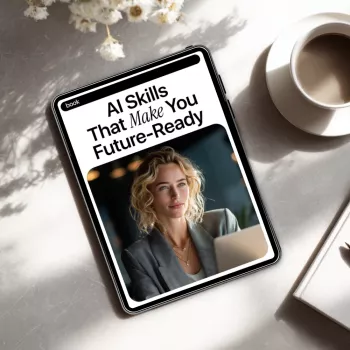
If you want a single “spine” for practical learning—foundations, exercises, and ready-to-use templates—start with a concise guide that organizes practice into repeatable routines. The AI Skills That Make You Future-Ready eBook is designed to help turn everyday tasks into measurable improvements.
For a work setup that supports consistent focus and professional presence while you build these habits, consider pairing your learning routine with a few desk-friendly upgrades like the Luxury 12-Inch Stainless Steel Decorative Tray for Home, Kitchen & Countertop for organizing essentials and the Luxury Men’s Automatic Mechanical Watch to keep time blocks honest during deep-work sessions.
FAQ
Which AI skills matter most if the job is not technical?
AI literacy, clear instruction-writing, verification habits, workflow design, and responsible use matter most because they improve daily work in any role. Practical examples include drafting and refining emails, summarizing meetings, standardizing recurring responses, and turning a repeated process into a documented SOP with a review step.
How can AI skills be proven on a resume or in an interview?
Show artifacts and outcomes: a short SOP, reusable templates, before/after work samples, a one-page analysis brief with assumptions, and a simple QA log. Add numbers wherever possible, such as hours saved per week, reduced turnaround time, or fewer errors after introducing a verification checklist.
What are the biggest mistakes when using AI at work?
The biggest mistakes are over-trusting outputs, skipping verification, sharing sensitive data, and giving vague requests that produce unreliable results. Avoid using AI for high-stakes decisions without a human review step, and document sources and checks so your work is defensible.















Leave a comment