-
Shop
- Adidas
- Advanced Technologies
- AI Career Advantage Collection
- AI Skills for Creators & Freelancers
- AI Client Management
- AI Ethics
- AI Mindset
- AI Tools & Prompts
- AI Writing & Content Creation
- Audio, Voice & Music
- Design & Visual Creation
- Email, Messaging & Communication
- Freelancing & Business
- Marketing, Ads & Conversion
- Productivity, Workflow & Automation
- SEO & Search Optimization
- Social Media Content & Growth
- Strategy, Planning & Analytics
- Video Creation & Editing
- AI Skills Mastery 2026 Collection
- Bathroom
- Best-Sellers
- Car Accessories
- Confidence
- Dating & Social Skills
- Digital Resources
- AI & Technology
- AI Skills
- Beauty
- Budgeting & Saving
- Car Buying & Ownership
- Cozy Feast Collection
- Electronics & Technology
- Entrepreneurship & Business Growth
- Financial Education
- Financial Independence
- Financial Mindset & Psychology
- Goal Setting
- Hobbies
- Home Styling & Organization
- Kitchen & Recipes
- Leadership
- Mindfulness
- Mindset
- Online Business
- Parenting & Child Development
- Personal Style & Fashion
- Pet Lifestyle & Wellness
- Positive Thinking
- Sleep Improvement
- Smart Life with AI
- Stress Management & Relaxation
- Travel Planning
- Wellness
- Yoga & Fitness
- Yoga & Mind-Body Practices
- Education & Learning
- Family & Parenting
- Fashion
- Furniture
- Gadgets
- Health & Beauty
- Health & Wellness
- Home & Garden
- Home Decor
- Home Electronics
- Kids & Babies
- Kitchen
- Kitchen Best-Sellers
- Lighting
- Luxury Brands Collection
- Nike
- Patio, Lawn & Garden
- Personal Growth
- Pet Care
- Pet Supplies
- Pets
- Smart Amazon Shopping
- Sport & Outdoors
- Stress Relief & Relaxation
- Travel
- Travel & Adventure
- Wealth
- Popular
- Best deals
Seasonal Wardrobe Planning: Outfit Formulas That Stick

Plan Your Wardrobe Smarter for Every Season (Without the “Nothing to Wear” Spiral)
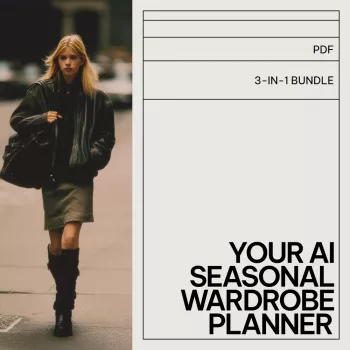
Season-to-season outfit planning gets complicated fast: shifting weather, events, dress codes, and the constant feeling of “nothing to wear” despite a full closet. Your AI Seasonal Wardrobe Planner Bundle – Plan Your Wardrobe Smarter for Every Season turns a scattered wardrobe into a clear seasonal system—so it’s easier to see what’s owned, spot what’s missing, build repeatable outfit formulas, and map what to wear across spring, summer, fall, and winter with less last-minute decision fatigue.
What this bundle helps solve
- Reduces daily outfit decisions by creating ready-to-use seasonal outfit options.
- Improves closet visibility: what’s worn often, what’s neglected, and what’s missing.
- Creates a plan for seasonal transitions (layering, temperature swings, and fabric swaps).
- Supports more intentional shopping by separating “needs” from “nice-to-haves.”
- Helps build consistency in personal style while still allowing variety.
Planning also supports a more resource-aware closet. Textile waste is a documented issue, and extending the life of what you already own (through smarter rotation, repair, and fewer single-use buys) is a practical place to start. For background, see the U.S. EPA textiles data and WRAP’s textiles resource efficiency work.
What’s included and how it’s typically used
- Season-by-season planning structure for organizing outfits, staples, and add-ons.
- Wardrobe inventory guidance to log key items (tops, bottoms, dresses, outerwear, shoes, accessories).
- Outfit-planning framework to create interchangeable looks based on lifestyle and climate.
- Gap-finding method to pinpoint the few items that unlock multiple outfits.
- A repeatable seasonal refresh routine to revisit every 3–4 months.
Seasonal planning snapshot
| Season | Core focus | Common wardrobe moves | Quick win |
|---|---|---|---|
| Spring | Versatile layers | Light jackets, transitional shoes, midweight knits | Create 5 outfits that work from cool mornings to warm afternoons |
| Summer | Breathable comfort | Linen/cotton, sandals, sun layers, event-ready basics | Build a 7-day rotation with 2 dress-up options |
| Fall | Smart layering | Boots, sweaters, structured outerwear, deeper colors | Define 3 layering formulas (top + mid-layer + jacket) |
| Winter | Warmth without bulk | Thermal base layers, coats, weatherproof footwear, accessories | Pre-plan cold-weather outfits to avoid repeating the same look |
A simple seasonal workflow to follow
- Step 1: Closet audit—pull out everything for the season and set aside items that don’t fit, don’t suit current needs, or need repair.
- Step 2: Lifestyle map—list weekly activities (work, errands, events, travel, workouts) and assign rough outfit counts to each.
- Step 3: Outfit formulas—choose repeatable combinations (for example: straight-leg pants + knit + jacket; dress + layer + shoe).
- Step 4: Build the rotation—plan a set of outfits that can be repeated and remixed, not a brand-new look every day.
- Step 5: Gap list—limit additions to high-utility items that create multiple outfits (avoid single-use purchases).
- Step 6: End-of-season review—note what was worn, what wasn’t, and what to adjust next season.
The workflow is designed to feel like a reset, not a full reinvention. Instead of chasing a “perfect” closet, it creates a dependable system you can reuse—especially when schedules get busy or weather swings make planning feel impossible.
Closet inventory that stays practical (not exhausting)
- Start with “most worn” items first: outerwear, everyday shoes, favorite jeans/pants, go-to tops—these drive most outfits.
- Use simple categories: essentials, work/event pieces, weekend/casual, active, and special-occasion.
- Tag pieces by function: layering, weatherproof, polished, breathable, travel-friendly.
- Record basic details that matter later: color, silhouette, fabric, and comfort level.
- Keep a small “fix/replace” list: tailoring, mending, cleaning, resoling—often cheaper than replacing.
A useful inventory isn’t a spreadsheet marathon. It’s a quick reference that prevents duplicate purchases and makes outfit building faster because the “good basics” are visible at a glance.
Building a capsule without feeling restricted
- Choose a base palette (2–3 neutrals) and add a few accent colors that match most tops/bottoms.
- Prioritize fabric and texture variety to avoid outfits feeling repetitive (denim, knit, crisp cotton, smooth layers).
- Aim for interchangeable ratios (example): 8–12 tops, 4–6 bottoms, 2–3 mid-layers, 1–2 outer layers, 2–3 shoes per season.
- Reserve a small “fun zone” for statement items to keep style personal without destabilizing the wardrobe.
- Plan for climate reality: a capsule in a humid region looks different than a capsule in a dry, cold region.
Outfit planning for real life: events, travel, and busy weeks
One underrated upgrade: a consistent “polished detail” you can repeat. A classic timepiece can elevate even a simple outfit formula without changing your whole closet. For a refined accessory option, consider the Luxury Men’s Automatic Mechanical Watch.
More intentional shopping and fewer regret buys
Getting started in under an hour
If you want a single place to keep that system organized, start with Your AI Seasonal Wardrobe Planner Bundle – Plan Your Wardrobe Smarter for Every Season. It’s built to be revisited—so each season feels simpler than the last.
Recommended in-stock picks
- Your AI Seasonal Wardrobe Planner Bundle – Plan Your Wardrobe Smarter for Every Season ($244.99)
- Luxury Men’s Automatic Mechanical Watch ($151.01)
FAQ
Does this work if the wardrobe is small or mostly basics?
Yes—planning is often easier with fewer pieces. Focus on a tight color palette, a handful of outfit formulas, and only the gaps that unlock multiple combinations.
How often should a seasonal plan be updated?
A light check-in every 2–4 weeks keeps the rotation realistic, and a fuller refresh each season helps you adapt to weather shifts and schedule changes.
Will this help reduce shopping and closet clutter?
It can by creating a clear gap list, revealing what you already repeat successfully, and limiting purchases to items that work with multiple outfits rather than single-use additions.
Recommended for you


Brass Dual-Handle Deck-Mount Sink Faucet Guide
Jun 23, 2026












Leave a comment